By Chance

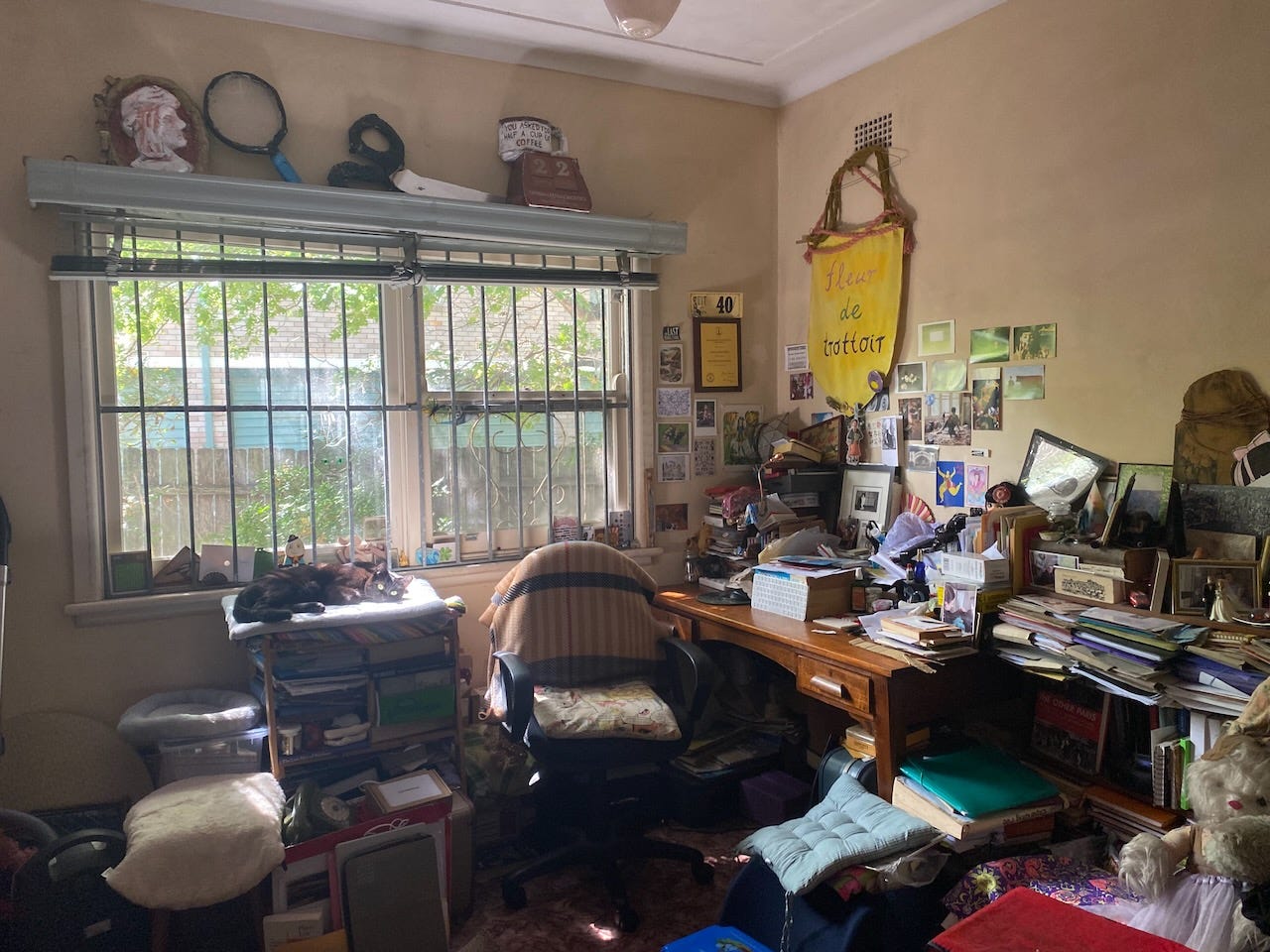
It’s winter and night comes early. But, as consolation, at this time of year the angle of the sun is such that sunlight comes in through my window for most of the day, striping over me as I sit at my desk, in the scene you see above. Teddy snoozing by the window, desk messy. Above the window are the object models from Calendar that S made for my reading at Outlet, a selection of talismans. There are a few actual objects I wrote about in Calendar visible here too: a green rotary dial telephone, a sheet of gold foil printed with a drawing of a rat, and other things too hidden to make out.
In Calendar news, a new review has just come out in Overland, by Courtney Powell: The Past in the Object: Vanessa Berry’s Calendar in which Powell connects Calendar to my zine-making practice, considers some of its recurring images: ‘rivers, eggs, apples, the colour green’, and considers the book as an object in and of itself:
It is a unique object in and of itself as much as it is about objects. Berry has constructed a feast of the personal for readers to devour, demonstrating that consumptive habits don’t need to be defined by algorithmic microtrends or unending accumulation. Memory and experience imbue the things we surround ourselves with far greater value.
It’s such a thoughtful review and I loved some of Powell’s own object stories that they share, about a tree branch (Calendar object 236), secateurs (45), a wayward packet of silica gel (82). The object stories people have told me after reading Calendar have been one of the best things about it being out in the world.
Also coming up soon, this time on Substack, will be an interview with me about Calendar by David Prater, on his Davey Dreamnation newsletter. We had a good long chat between Sydney (me) and the Netherlands (David) about how and why I wrote the book, and some of the ideas that went into its making.
I have a few wintertime Calendar-related events, a reading in June and two workshops in July. The reading is for the winter solstice, at Rogue Gallery on Saturday, 20th June, for the closing of Maria Pia Mosquera’s exhibition Juju, and I’ll be reading some of the objects from Calendar that relate to the paintings in the show (four-leaf clovers! apples! keys! and some of the spooky objects more generally - the planchette!)
In July I’ll be in Naarm/Melbourne for two workshops with The Paperback Bookshop.

The first is the ‘Day of Slow’ on July 18th, with Olivia Meehan (author of Slow Looking) and Anna MacDonald (author of A Jealous Tide) - see A Day of Slow: Listening, Writing and Looking with Objects for the schedule. We’ll be sharing approaches for looking at, living with, and thinking through objects, and will start at Coates Community Arts on Collins Street, before moving over to the NGV.
Then on July 19th I’ll be leading the Topography of Chance workshop at Paperback Books’ new event space. It’s an afternoon workshop exploring ideas of noticing and working with material from everyday life, and harnessing the powers of chance and serendipity in your writing. The name is borrowed from one of my favourite chance-based artworks, Daniel Spoerri’s An Anecdoted Topography of Chance (of which, more below).
Both will be convivial events with cups of tea and a cosy winter writing mood. I’m looking forward to wearing one of the big old heavy vintage coats that lie in wait in my wardrobe for just such a Naarm winter trip and stretching out into a weekend of object writing.
Object of the Month (in which I expand on some of the objects I write about in Calendar)
8. Airline Blanket
For most of my objects of the month in this newsletter I choose an object that’s from the same month in which I’m writing, but this time I chose the airline blanket, prompted by Courtney Powell’s review. They reflect on how some objects in the book leave their personal significance to me open for the reader to imagine. For the airline blanket, “It’s never clear who took the blanket from the plane, or why, how Berry acquired it and when this occurred, or how long ago it was.”
This made me realise that some of those questions are a mystery for me, too: S bought the blanket from an op shop, maybe 20 years ago? We like the idea of the airline blanket having a new, earthbound life, going on picnics, relieved of its midair duties. On long flights I have always been grateful for airline blankets, though they’ve become noticeably thinner and less appealing over the years I’ve been travelling: cheaper to make, and less desirable to steal. The Korean Airlines blanket is a sturdy synthetic fabric with a plaid pattern, and is still our picnic rug of choice.
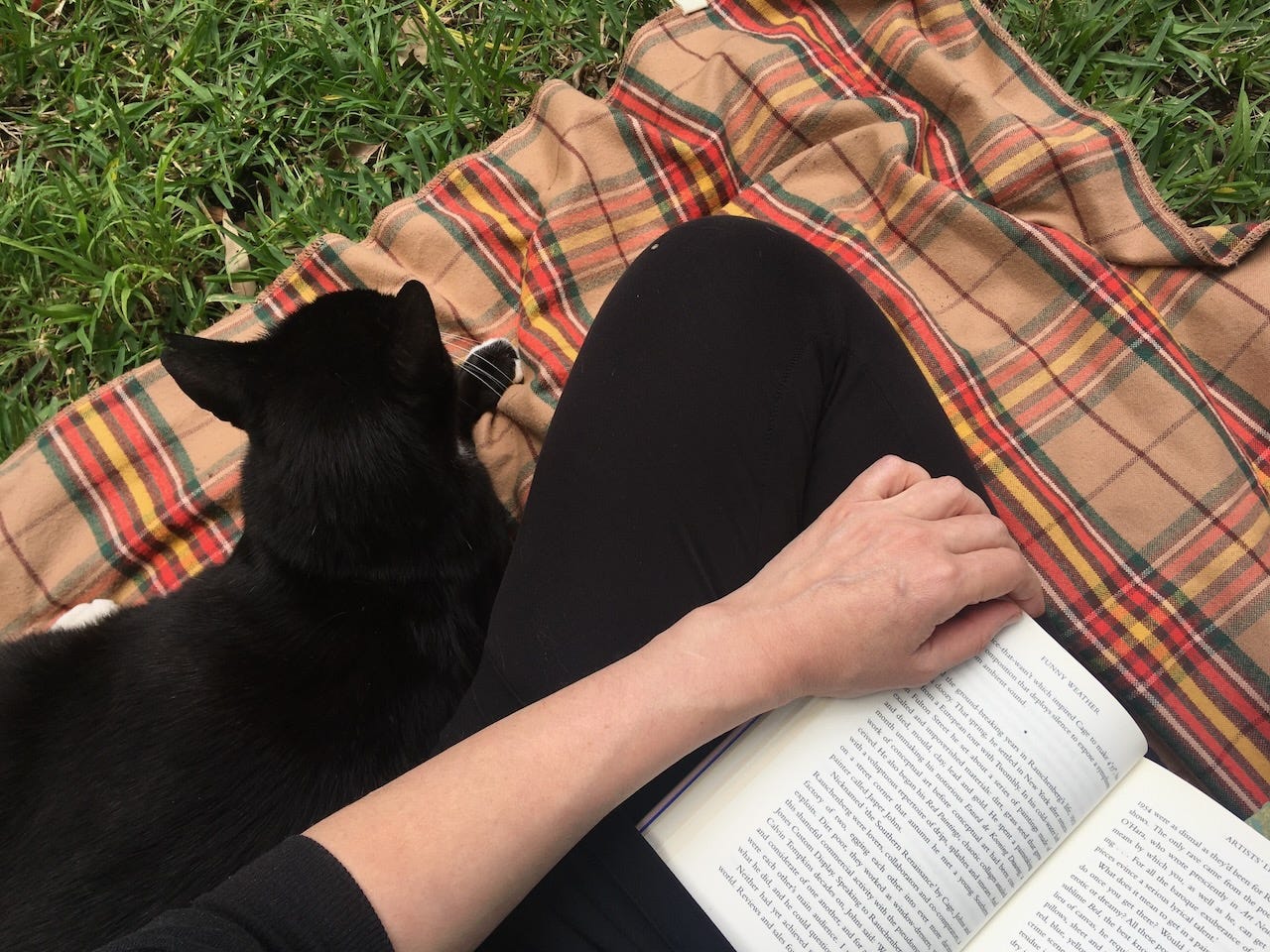
Searching for airline blanket information, I hoped to come across a blog that has a comprehensive catalogue of airline blanket patterns over the years, but alas, no such thing exists as far as I can find. I’m sure there are aviation enthusiasts who collect them, but they’re elusive objects to track down. They exist mostly in the no-space and no-time of long haul flights, but sometimes, one escapes.
Object Project: An Anecdoted Topography of Chance by Daniel Spoerri (with Robert Filliou, Emmett Williams and Dieter Roth)
I knew Daniel Soperri first for his ‘snare pictures’ - for which he would affix the plates, cups, cutlery and detritus left over after a meal to the tabletop, which he’d then hang on the wall like a painting. But it wasn’t until I was poking around in my friend Sarina’s excellent book collection that I found his book that works off the same principle: An Anecdoted Topography of Chance, first published in 1962.
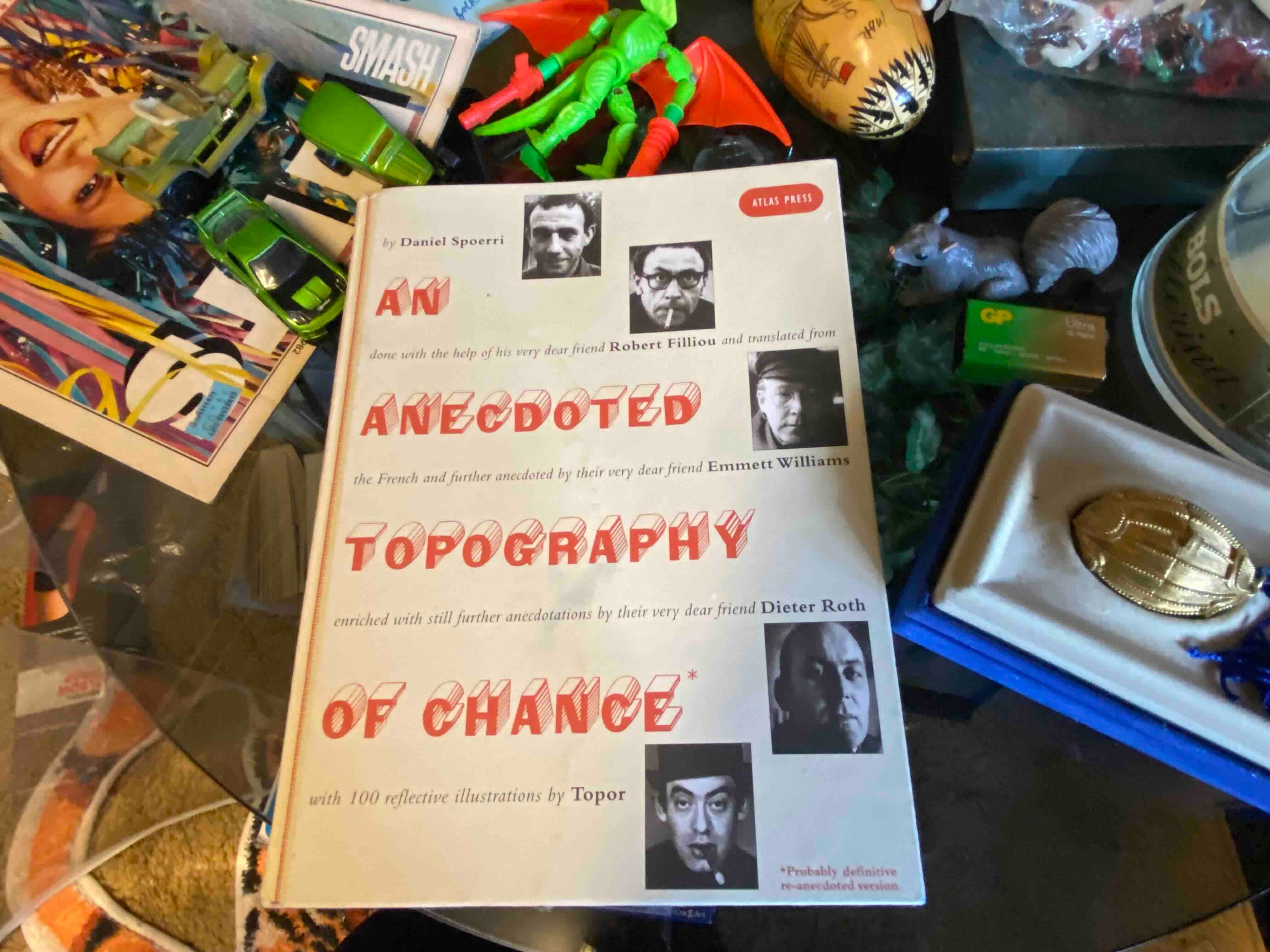
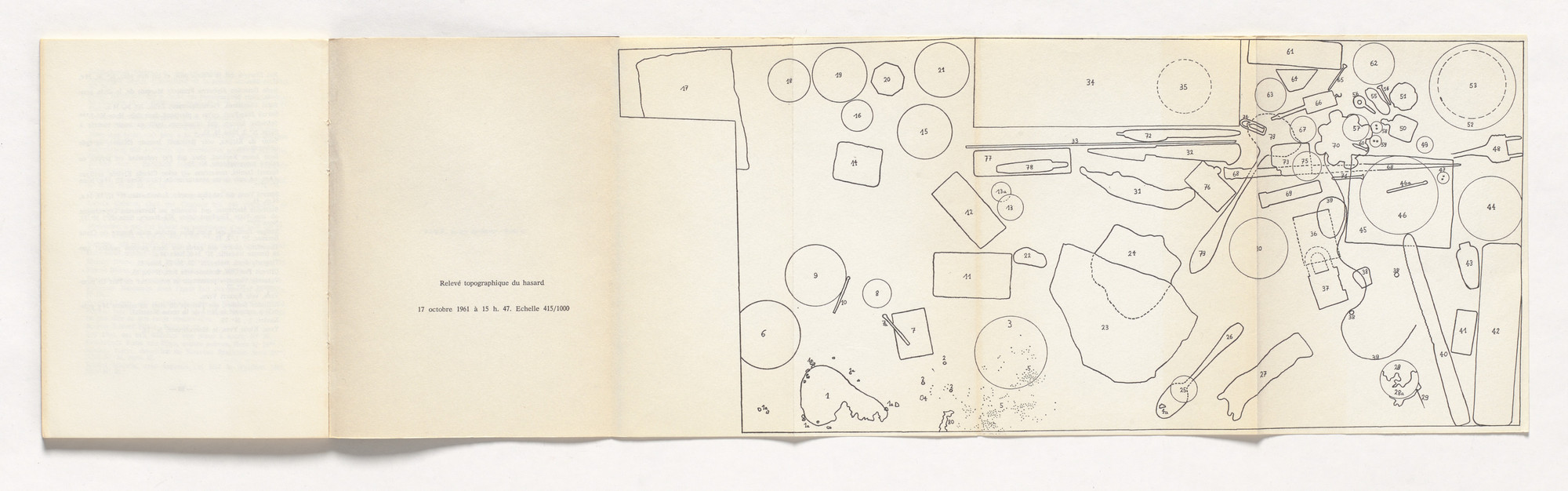
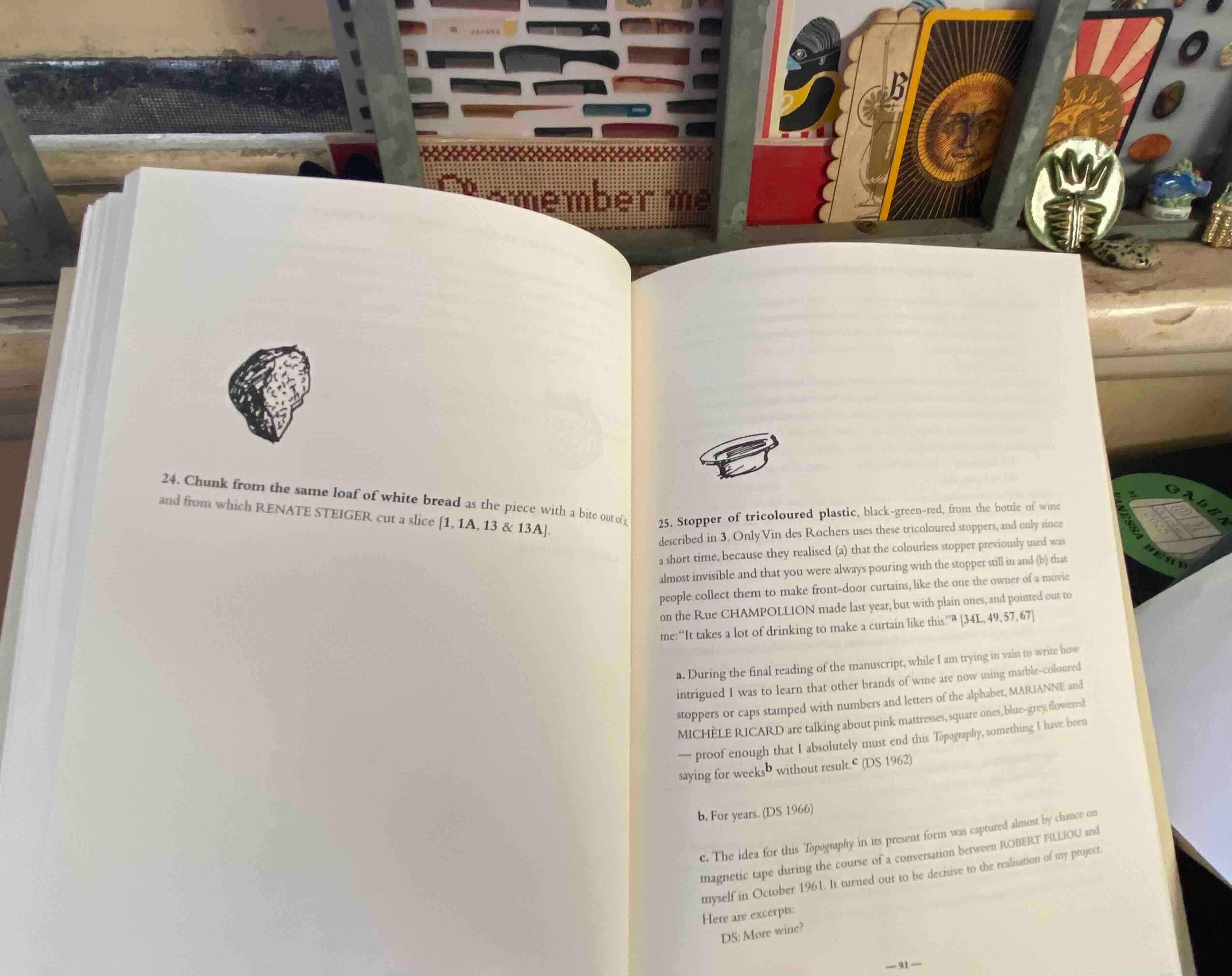
The book is a collection of 80 objects, all of which originated from a kitchen table arrangement in 1961, which are listed and described by Spoerri, and then the descriptions annotated by Spoerri and friends, through multiple editions. The first edition was 54 pages long, the final, published in 1995 and pictured above among a selection of our own table objects, is 271 pages, with multiple introductions and appendices. You can take a look at the 1966 version on Monoskop.
It’s equally a conceptual art project, artist’s book, extended conversation, and eccentric encyclopedia, as one by one it presents the objects from the table - pale-green egg cup, burnt match, jar of celery salt, white shirt button, and so on - which correlate to a map printed on the inside cover. The initial description of the object is interrupted by notes which branch out alphabetically. A few items have no notes or only one or two, some have many (alarm clock, for example, goes all the way to ‘o’), and within these the notes are often annotated with further notes. In this way it suggests every object could branch out indefinitely, that every object has the potential to stretch out into complex webs of associations. There’s something, too of the spirit of rambling conversation to it, which was how the project started in the first place.
*
The final piece of news I have for now is that I’ve been working on a new I am a Camera, number 26, which I am planning to have finished in time for the Other Worlds zine fair. The fair is on July 11th this year, at Peter Forsyth auditorium, beside the Broadway Shopping Centre.

See you there, or maybe at one of the workshops. Enjoy the advance towards the solstice, whether your days are long or short at this time of the year.
Vanessa.
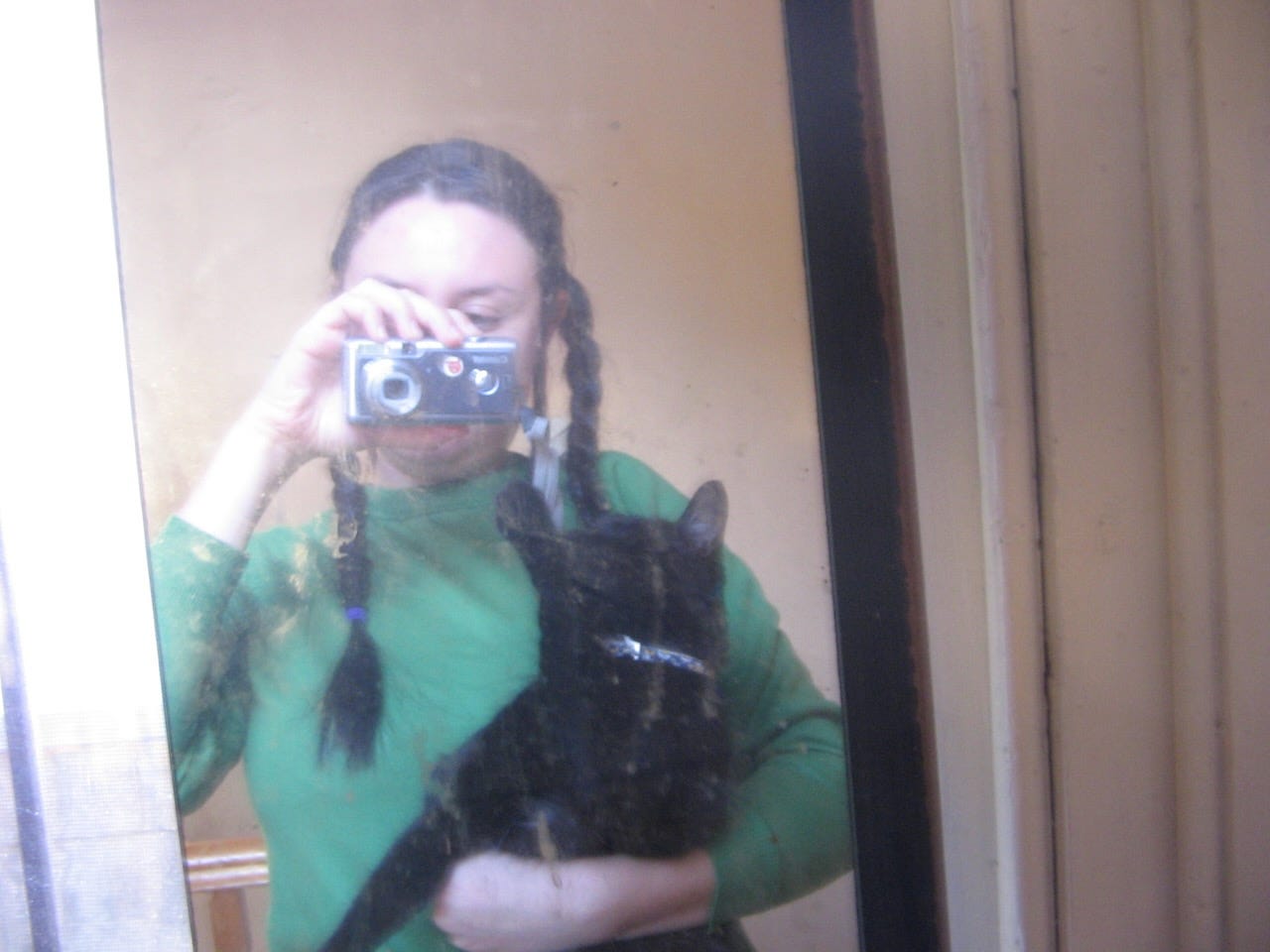
p.s. I’ve recently been looking through photos from 2006 and to round out my winter newsletter with a third Significant Black Cat, here I am with Mickie and the Canon PowerShot A400.