
Portraits

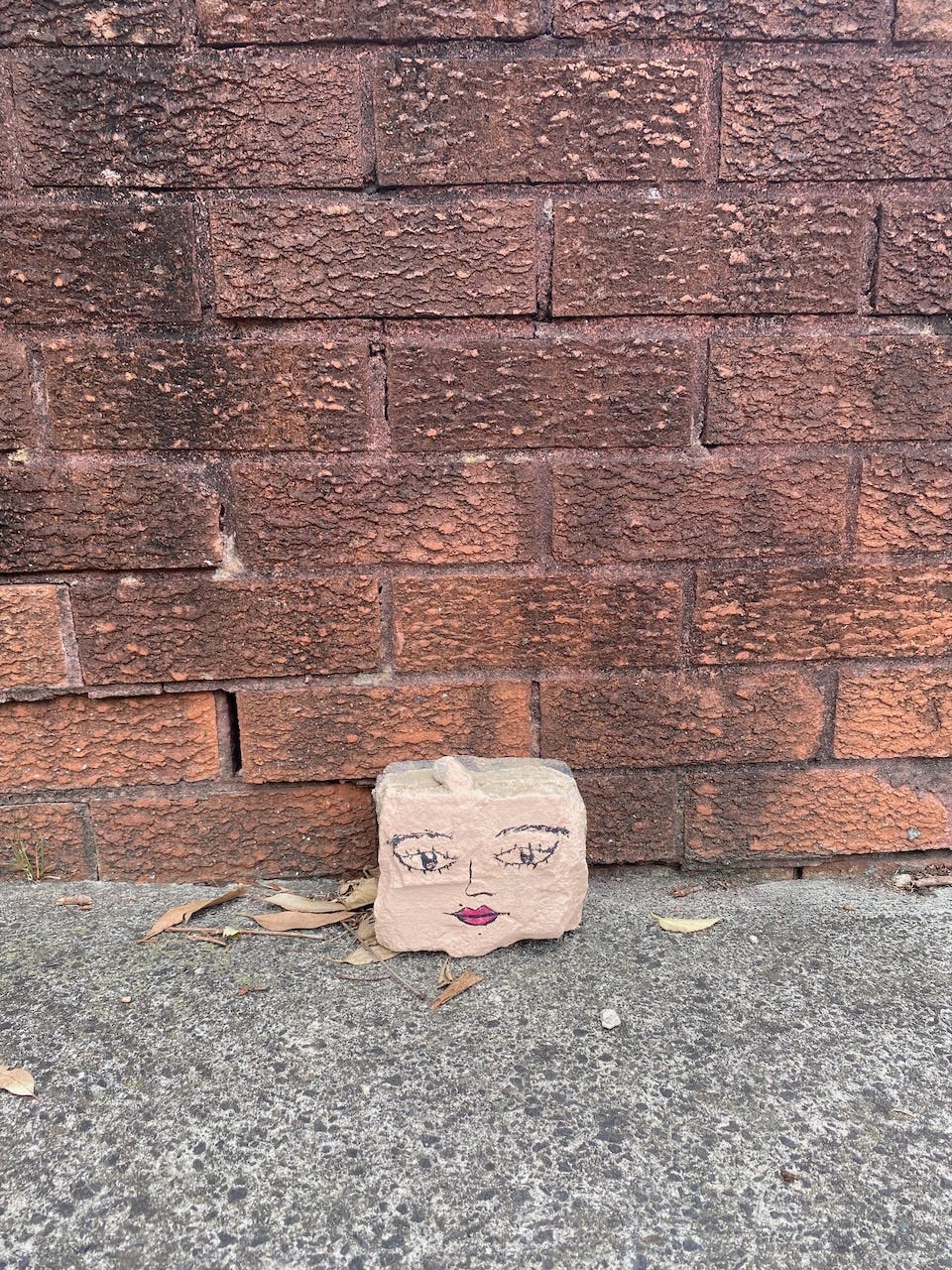
Walking home one hot, humid afternoon, tired out from the day, you come across a brick that someone has carefully painted a face onto. It is a small enough thing, but it cheers you. Anything that lifts your spirits, even briefly, is welcome. You get home and the cat appears from where he’s been curled up sleeping all day to greet you. You put your bags down, take off your shoes, think about posting the photo of the brick to Instagram, but then decide to keep it just for you.
*
It’s a weekend morning, sunlight is twinkling in the bright green leaves of the oak tree outside, and the cat is snoozing behind me, planning his takeover of my office chair the moment I move. Muriel Spark had this to observe about cats and writing, in A Far Cry From Kensington:
If you want to concentrate deeply on some problem, and especially on some piece of writing or paper-work, you should acquire a cat. Alone with the cat in the room where you work … the cat will invariably get up on your desk and settle under the desk lamp. The light from a lamp … gives the cat great satisfaction. The cat will settle down and be serene, with a serenity that passes all understanding. And the tranquillity of the cat will gradually come to affect you, sitting there at your desk, so that all the excitable qualities that impeded your concentration compose themselves and give your mind back the self-command it has lost. You need not watch the cat all the time. Its presence alone is enough. The effect of a cat on your concentration is remarkable, and very mysterious.
True, I say, although my own concentration is more due to the fact I don’t dare to get up from my position at the desk. If I do I will lose my seat to the serene, tranquil one who immediately affects an attitude of deep sleep the moment he takes up the coveted position.
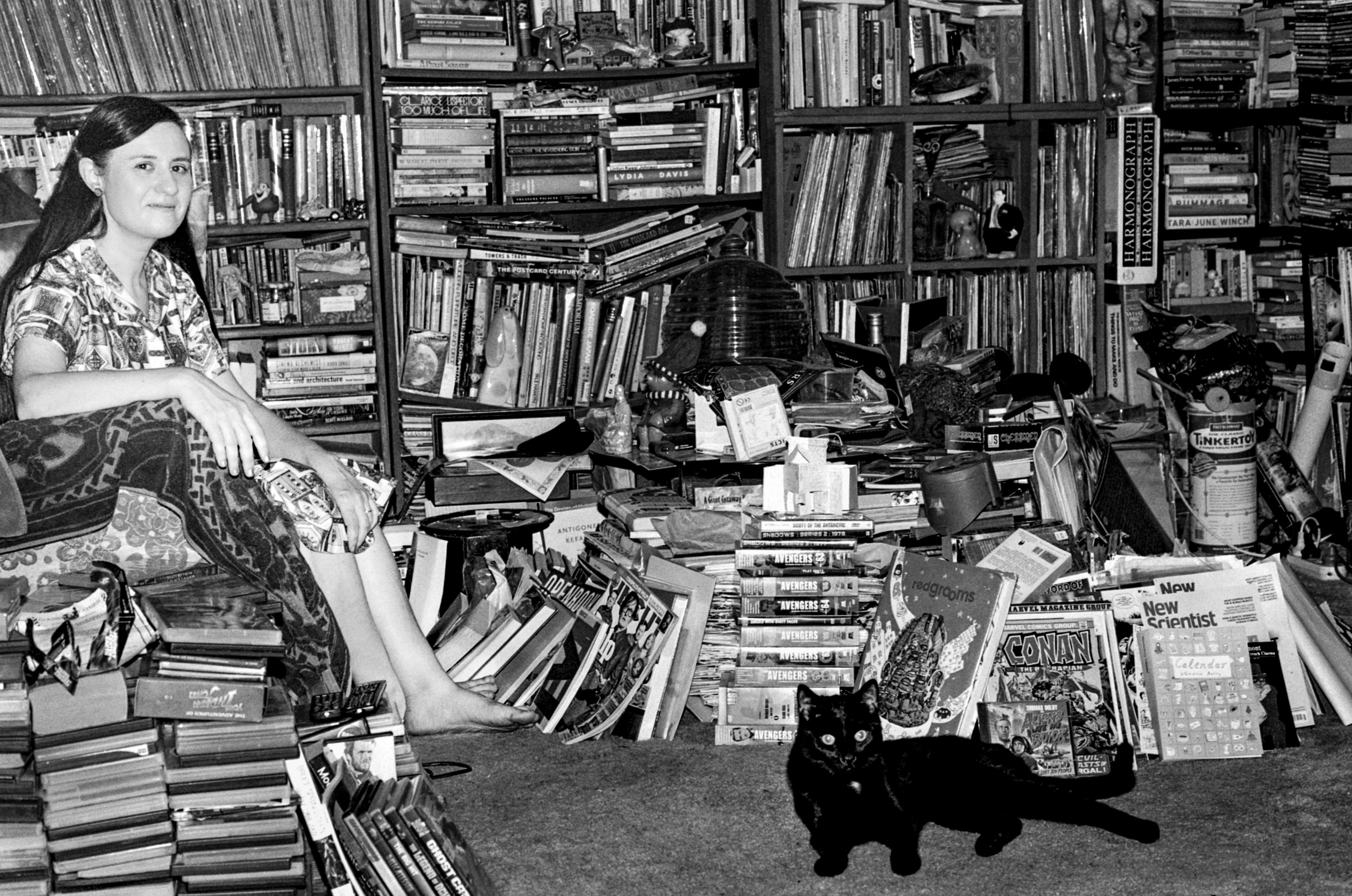
I’m a fan of writer’s cat stories and enjoy a literary cat memoir (my favourite is May Sarton’s The Fur Person). Same with portraits of writers and their cats. So, when photographer Nash Ferguson came to visit me at home last year, I was thrilled to have her take my own.
*
There have been some good Calendar related happenings lately. Kirsten Krauth wrote a lovely review in Australian Book Review (paywalled), observing that “Berry has many passions or, some would say, obsessions”. This is true! She writes:
With Berry’s flair for lyricism, the object-to-a-page often reads like a prose poem, a modern ode to the recycled, the forgotten, the passed over, an antidote to the radical decluttering of Marie Kondo. Calendar is a special book that changes the way you view the world and the objects that surround you; it is to be dipped into and savoured – once a day – to honour the way it was written.
I am also the first featured artist in the new newsletter series Close Reading, in which a guest writer shares one word, one quote, one poem, one book, and “one other thing”: the newsletter is well worth signing up to. The previous newsletter by Close Reading’s Heath Killen, In Wild Air, was a weekly inbox highlight when it ran 2016-2018.
February/March also saw S having an exhibition at Numbers Sydney, a new gallery in Potts Point. His exhibition, Apparitions, was of optical illusion artworks and you can read my interview with him about it here.
Object of the Month (in which I expand on some of the objects I write about in Calendar)
Pencil Tin
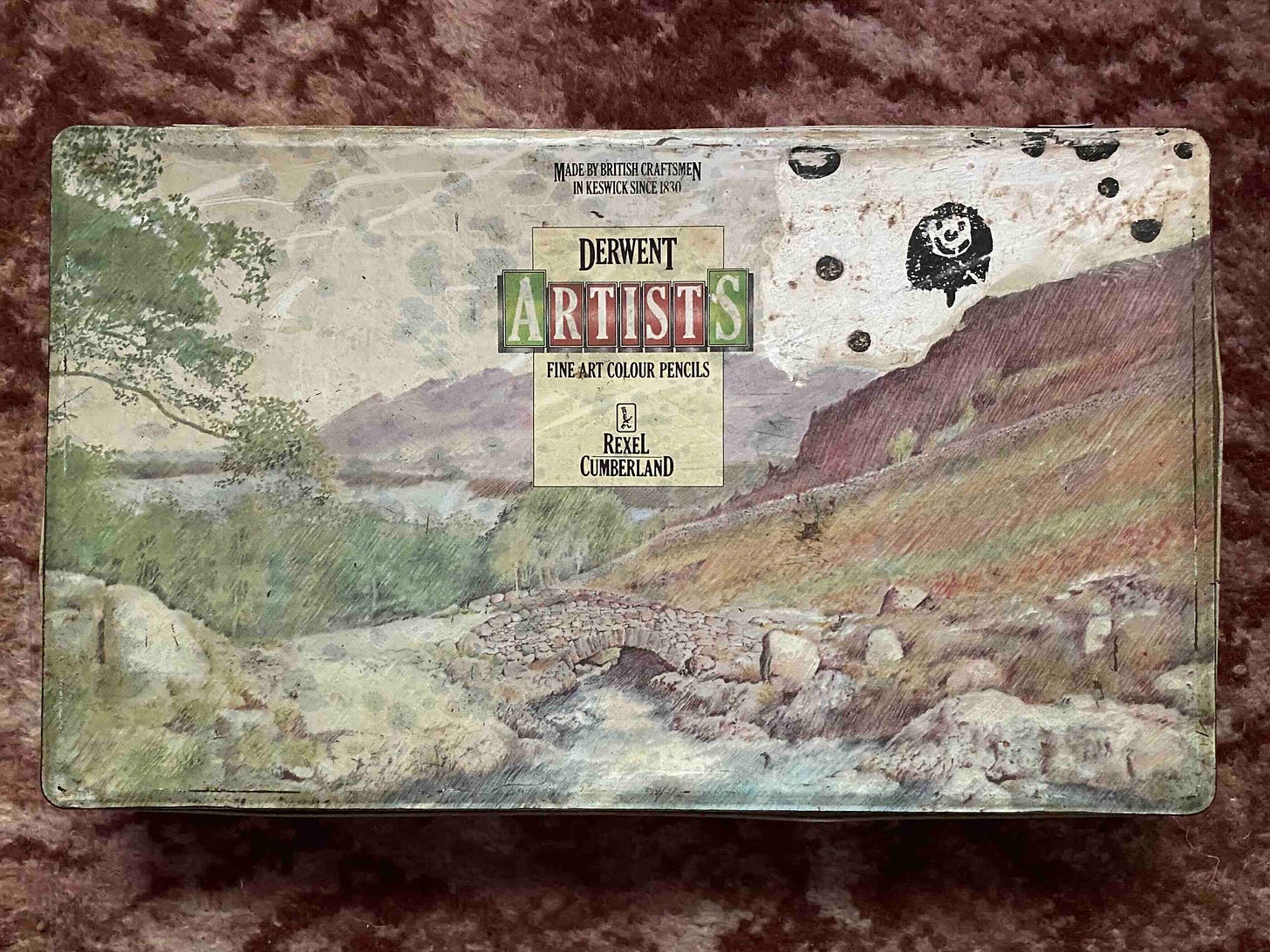
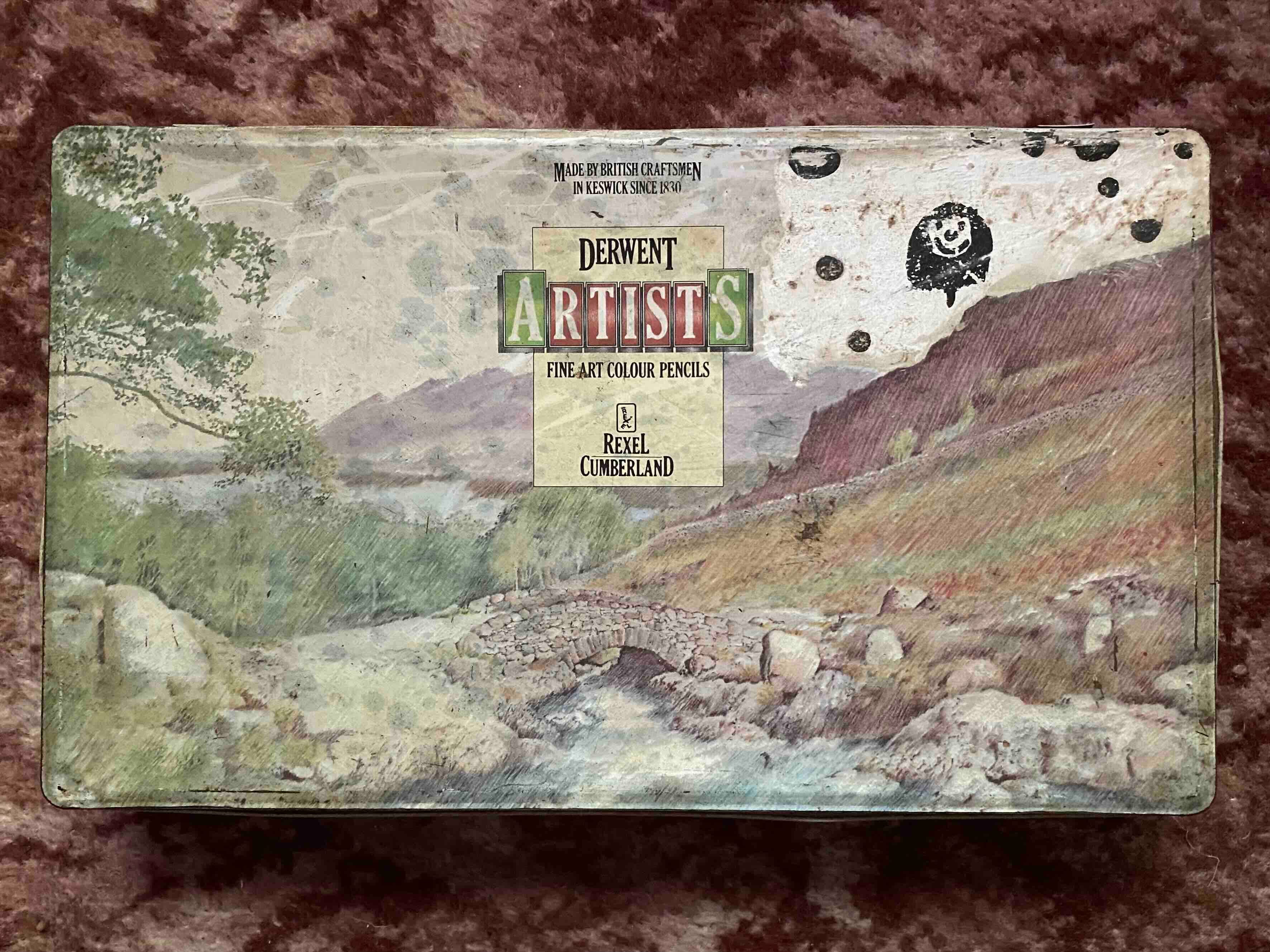
I’ve kept this tin of 72 Derwent coloured pencils since I was given them as a child. Then, they made me feel as if I had the power to make anything I wanted to, and I enjoyed the descriptive names of the colours etched into the pencil in gold: Rose Madder Lake, Kingfisher Blue, Burnt Carmine. The shortest of the pencils in my tin, the ones which must have seen the most use, are black, white, and Jade Green. Some of the Derwent colours are so distinct that they have become reference points for me: Emerald Green the colour of grass in a cartoon, and Magenta, a colour exactly on the edge of red and blue.
In the story I wrote for Calendar, I remember drawing the cartoon head in the corner of the tin, and then being disappointed that I’d ruined the tin with my clumsy personalisation of it. It is a familiar feeling: I still encounter it when I make an attempt to customise something that doesn’t quite live up to my ambitions. If I wanted to sell the tin on Ebay it would no doubt bring the price down from the $1000 such sets usually sell for. (!)
Object Project: Perfection by Vincenzo Latronico (trans. Sophie Hughes)
A tribute to Georges Perec’s Things: a story of the sixties (trans. David Bellos), this short novel follows the original by tracking the lives of a young couple who are caught up in the zeitgeist, but struggle to keep up with it its changes. In Perec’s novel this is 60s consumerism, and in Perfection it is the late-capitalist gig economy.
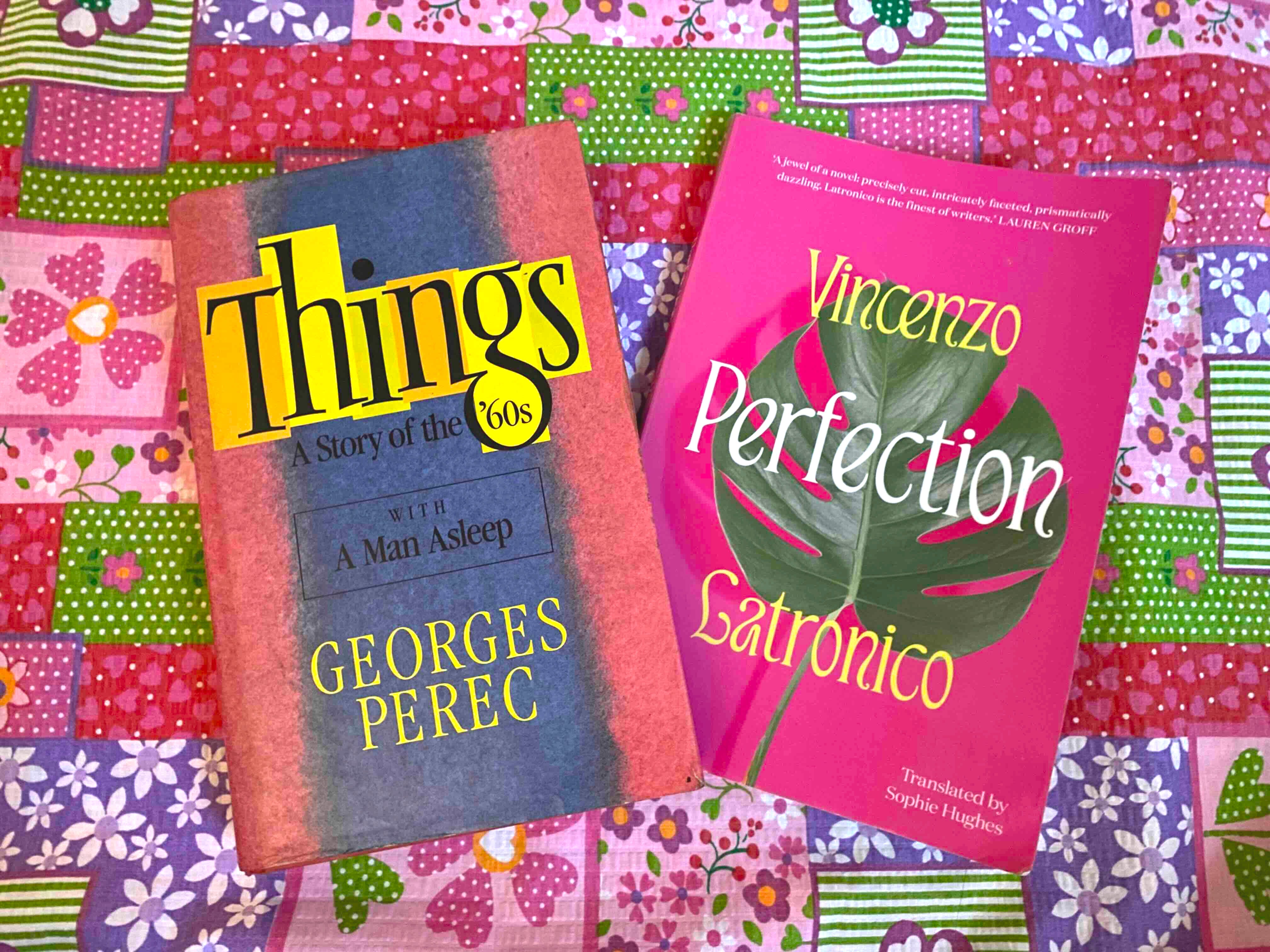
Perfection begins with a description of the couple’s apartment, as each room appears in the photographs on Airbnb. This section, ‘Present’, forms an introduction and the next section, ‘Imperfect’, announces both the tense the novel is written in (the same as Perec’s), and shows the reality outside of the photographs: ‘Reality didn’t always live up to the pictures’.
In Things, the couple live in a small apartment with a mariner’s chart on the wall in the living room and displays of knick-knacks “agates and stone eggs, snuffboxes, candy-boxes, jade ashtrays…” They find charm in untidyness. In Perfection untidyness is what breaks the illusion:
And then there were the things. Things absolutely everywhere: the chargers, the receipts, the bicycle pump, and the endless stream of forms and reminds that constituted German bureaucracy; the herpes cream, the tissues - fresh packs, used or scraps that had been through the wash - the wool felt innersoles, the sunglasses case, the odd glove they still hoped to match with its pair, the tangled earphones.
Both novels are critical of the ways of life they describe, which is bound up in the pleasure of richly describing them, articulating their details. In Perfection this life, despite the digital existence the couple lead, it is littered with objects, which take on added significance through being acceptable, or not, to their lifestyle. It’s a precise, thoughtful novel, a portrait of a place, time and way of life, and a reminder that no matter how digitally oriented we are, we are still physical beings in a physical world.
*
I’ve been working on my project about Sydney bookshops, and have published Part 2 of my survey of them now. On to making the map!
In object news, although I have vowed to resist any more typewriters, I came across a Facit T2 typewriter with a wide carriage, which makes it possible to type on larger paper sizes than the usual A4. I had to! What will I make with it? Maybe something for Other Worlds zine fair (happening on July 11th, this year).


Go well into your autumn or spring,
Vanessa.
I didn’t know Perfection was linked to Perec - and now I must read both! I have Species of Spaces which suits my short attention span. New typewriter sounds v inspiring.